
Extended Reality (XR) is reshaping how people interact with technology inside immersive environments. Within the Metaverse, it serves as an umbrella concept that blends physical and virtual experiences into one connected system. As more users spend time in interactive spaces, this technology becomes essential for communication, learning, and creativity.
Today, businesses, educators, and creators rely on immersive tools to engage audiences in meaningful ways. These tools allow users to move beyond flat screens and step into a shared digital world. As a result, immersive experiences feel more natural and responsive.
This article explains what Extended Reality means, where it came from, and how it works in practice. You will also learn about its core components, major types, advantages, limits, and real-world applications. By the end, readers will understand why this technology plays a growing role in modern virtual ecosystems.
What is Extended Reality (XR)?
Extended Reality (XR) is a broad term that describes technologies blending physical and virtual environments. It includes immersive systems that change how users see, hear, and interact with digital content. Instead of separating reality and simulation, this approach connects both into one experience.

The purpose of this technology is to enhance perception and interaction. Users can engage with virtual objects while remaining aware of their surroundings or fully enter simulated spaces. This flexibility makes it valuable across industries.
Within immersive platforms, it supports communication, collaboration, and content creation. Designers use it to build realistic simulations, while learners benefit from hands-on practice. As tools improve, this technology continues to support the development of Digital skills needed in modern workplaces. Its role in immersive ecosystems keeps expanding as hardware and software become more accessible.
Background of Extended Reality
Extended Reality consists of several core elements working together. Each element contributes to immersion, interaction, and realism. Although implementations differ, most systems share common features.
Hardware provides visual, audio, and motion input. Software processes data and renders environments in real time. Connectivity allows shared experiences across platforms.
List of Key Components or Aspects:
- Head-mounted displays or smart glasses
- Motion tracking sensors and cameras
- Real-time rendering software
- Input methods like controllers or gestures
- Network support for shared experiences
Together, these components create responsive environments that adapt to user actions.
History of Extended Reality
The idea behind Extended Reality evolved from early virtual simulation research. During the late 20th century, scientists explored computer-generated environments for training and visualization. Early systems were expensive and limited to laboratories.
In the 2000s, improvements in computing power made immersive tools more practical. Over time, developers combined different immersive technologies under one concept. This shift allowed smoother integration across platforms and industries.
| Year | Milestone |
|---|---|
| 1960s | Early immersive display experiments |
| 1990s | Virtual simulation research expands |
| 2010s | Consumer-grade immersive devices emerge |
| 2020s | Unified XR adoption across industries |
Types of Extended Reality (XR)
This includes several distinct types, each serving a specific purpose. These categories differ in how much of the physical environment they replace or enhance.
Virtual reality creates fully immersive environments that block out the real world. Augmented systems overlay digital elements onto physical surroundings. Mixed approaches blend both by anchoring virtual objects to real spaces.
Each type works through specialized hardware and software. Some focus on full immersion, while others emphasize real-world interaction. Together, they allow flexible experiences across entertainment, education, and professional use cases.
How Does Extended Reality Work?
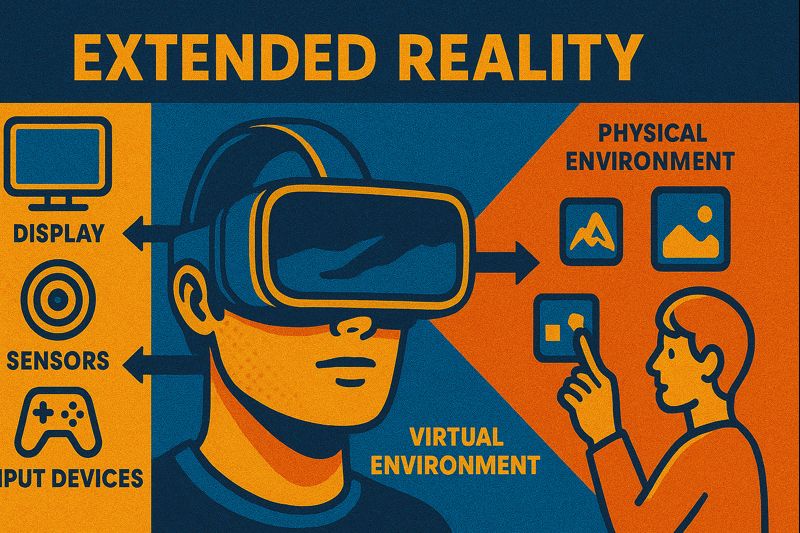
Extended Reality works by combining sensors, displays, and software processing. First, sensors track user movement and surroundings. This data helps the system understand position and orientation.
Next, software processes the information and renders digital content in real time. Visuals adjust instantly as the user moves. Audio feedback often changes as well, improving realism.
Finally, input methods allow interaction. Users can touch, gesture, or speak to control elements. Through this process, immersive environments feel responsive and engaging.
Pros and Cons
It offers strong benefits but also presents challenges. Understanding both sides helps users decide how to apply it.
| Pros | Cons |
|---|---|
| Enhances immersion and engagement | Hardware costs can be high |
| Improves training and visualization | Requires technical setup |
| Supports remote collaboration | May cause user fatigue |
Applications of Extended Reality (XR)
Extended Reality supports many real-world applications. In education, it enables interactive lessons and simulations. In business, teams collaborate in shared virtual spaces.
Healthcare and Training
Professionals practice procedures in controlled environments.
Design and Engineering
Creators visualize concepts before physical production.
Entertainment and Social Platforms
Users explore immersive experiences within the Metaverse.
These uses highlight how immersive technology continues to expand across industries.
Resources
- Techopedia. (XR) – Definition
- GeeksForGeeks. What is Extended Reality?
- The Intellify. What is Extended Reality?
- ArborXR. What is Extended Reality?
- Ready Set VR. XR Definition, Solutions and Examples