
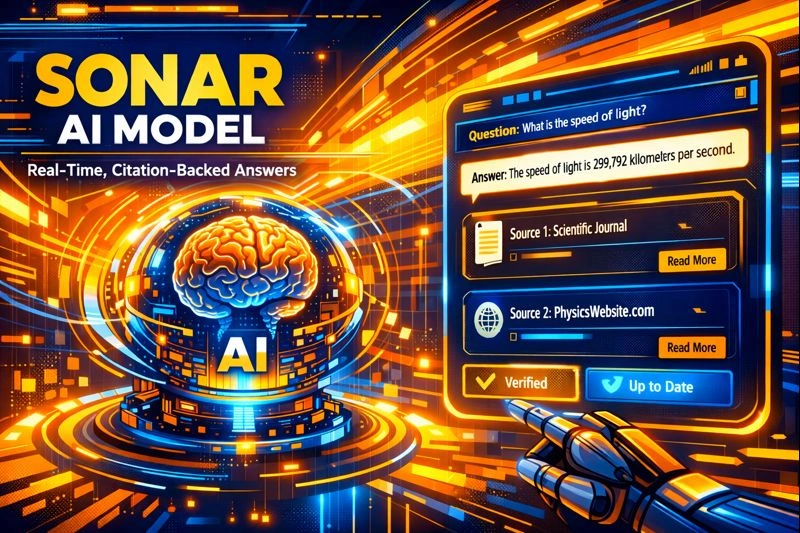
Sonar is an advanced generative model developed by Perplexity, designed to enhance the platform’s ability to deliver faster, more accurate, and context-aware answers. It powers real-time information retrieval by combining large language model reasoning with dynamic web search. Rather than simply generating text, Sonar interprets questions, gathers relevant data, and produces verified, natural-language responses with citations.
Built to push the boundaries of modern artificial intelligence, Sonar represents Perplexity’s step forward in making AI-driven discovery more transparent and reliable. It demonstrates how retrieval-augmented generation can evolve into a system that not only understands queries but also verifies them with real-world data.
This article defines Sonar, explains how it works, traces its origins, and explores its applications across industries. By the end, you will have a clear overview of how this innovation from Perplexity is reshaping intelligent search and AI-powered reasoning.
What is Sonar
Sonar is a large-scale generative model that powers Perplexity’s answer engine, combining deep learning, web retrieval, and contextual understanding. It is built to generate responses that are factual, up-to-date, and supported by credible sources.
Unlike standalone chatbots that rely solely on pre-trained data, Sonar continuously pulls information from the web. This design ensures that users receive answers grounded in real-time knowledge rather than outdated training data. The model integrates natural language processing, neural search, and retrieval-augmented generation (RAG) to produce concise and verifiable results.
Perplexity introduced Sonar to strengthen its answer engine’s intelligence, making it capable of understanding nuanced questions and responding in ways that mimic expert-level reasoning. The model also optimizes the retrieval and generation pipeline, improving both speed and factual precision.
Essentially, Sonar serves as the core intelligence layer behind Perplexity’s search ecosystem. It brings together human-like comprehension and data-driven verification, defining a new standard for trustworthy AI interaction.
Background of Sonar
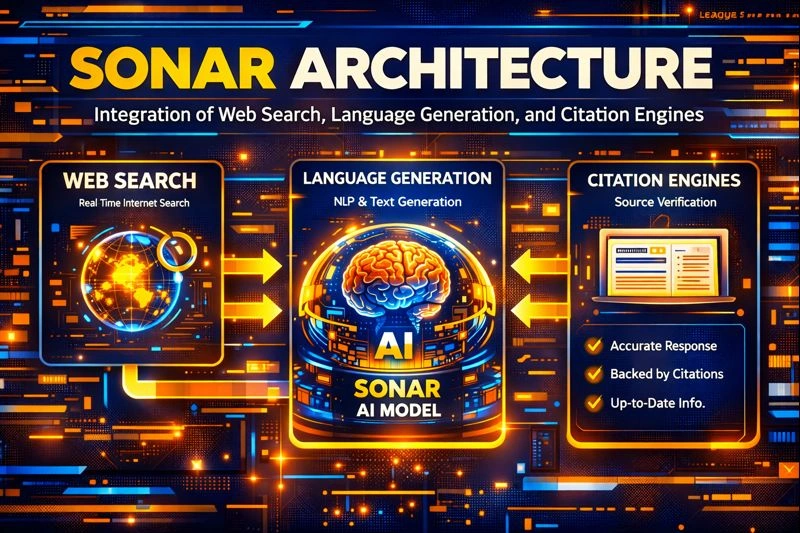
Sonar operates through a carefully structured process that merges machine learning algorithms with live web retrieval. When a user submits a query, the model breaks down the question into its semantic components to determine what kind of information is needed. It identifies intent, related terms, and the underlying context before searching for relevant material across multiple sources.
Once potential information is retrieved, Sonar evaluates the quality and reliability of each source. It then synthesizes the most relevant data through its generative layer, which crafts a natural-language response that reads smoothly while maintaining factual accuracy. Each answer is supported by citations or linked references, enabling the user to trace where the information originated.
This workflow reflects Perplexity’s goal of transparency and accountability in AI. While most large language models respond based on stored training data, Sonar continuously updates its knowledge by drawing from current online resources. This ensures that responses evolve alongside real-world developments, whether in science, technology, or global news.
The system also uses contextual chaining, allowing it to remember and relate previous questions within a session. This helps Sonar sustain coherent conversations and maintain relevance throughout extended user interactions. In effect, it becomes a research companion capable of providing detailed explanations, comparative analysis, and follow-up insights.
Perplexity designed Sonar with adaptability in mind. It can manage diverse content types — from academic research and technical documentation to creative prompts and business reports. Its retrieval-augmented structure makes it suitable for any task that requires accurate, evidence-backed reasoning.
In addition, Sonar’s architecture reflects advancements in efficiency and latency reduction. The model is optimized to process multiple search queries simultaneously, ensuring rapid responses even during complex information requests. This combination of speed, accuracy, and contextual depth has made it one of the most powerful retrieval-based systems in artificial intelligence today.
History or Origin of Sonar
Sonar was introduced by Perplexity in 2024 as a response to the growing need for more accurate and accountable AI systems. It was born from the vision of Aravind Srinivas and his team, who originally launched Perplexity AI in 2022. The aim was to move beyond traditional language models and create a tool that could verify its knowledge in real-time.
Following the success of Perplexity’s initial answer engine, the development team focused on increasing reasoning capabilities and real-time search depth. This ambition led to the launch of Sonar, which became the foundation of Perplexity’s next-gen search experience. It rapidly became available across both free and Pro versions, gaining popularity among professionals and general users alike.
| Year | Milestone |
|---|---|
| 2022 | Perplexity AI founded by Aravind Srinivas |
| Late 2022 | Launch of original Answer Engine |
| 2024 | Release of Sonar model |
| 2024–2025 | Integration of Sonar into all platforms |
| 2025 | Expansion of Sonar into enterprise and creative tools |
Types of Sonar
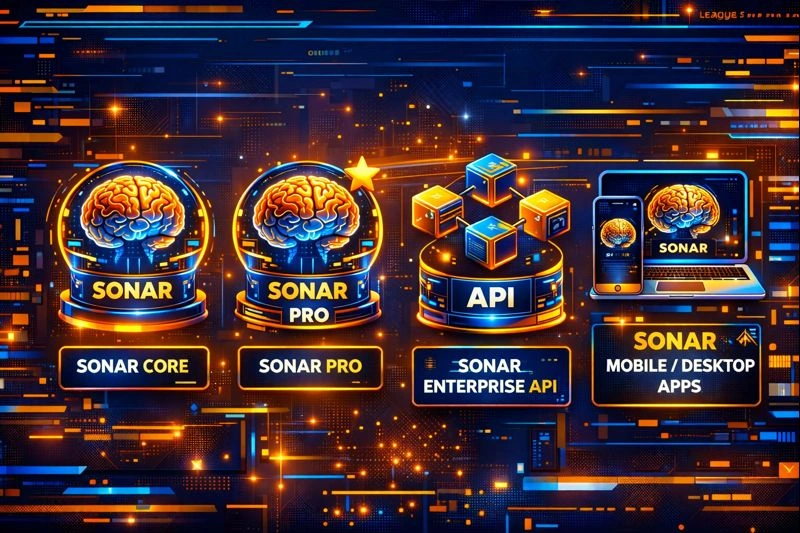
Perplexity has deployed Sonar in various forms to suit different user needs and technical environments:
- Core Sonar Engine: The default model used across Perplexity’s platform, delivering general and expert-level responses.
- Sonar Pro: Enhanced with access to larger models, in-depth document analysis, and multi-topic tracking.
- Mobile and Desktop Versions: Sonar powers real-time searches in Perplexity’s apps and browser tools.
- Enterprise API Integration: Custom deployment for corporate data environments, enabling internal knowledge search.
Each type serves a unique purpose, from consumer-level Q&A to deep enterprise research and automation.
How Does Sonar Work?
Sonar operates through a multi-step process:
- User submits a question via Perplexity’s interface.
- Sonar interprets the query, breaking it down semantically.
- The system searches online sources and retrieves relevant information.
- Generative AI synthesizes a response based on real-time data.
- Citations are included to verify accuracy and source credibility.
This process results in trustworthy, conversational answers that align with the latest available information.
Pros and Cons of Sonar
| Pros | Cons |
|---|---|
| Provides real-time, citation-backed answers | Dependent on web access for optimal results |
| Handles complex queries with contextual understanding | May not retrieve niche sources behind paywalls |
| High-speed processing with low latency | Premium features require a Pro subscription |
| Supports multi-turn conversations | Accuracy depends on the quality of source data |
| Scales across industries and devices | Enterprise integration requires custom setup |
Applications or Uses of Sonar
Search and Research
Sonar transforms the way people conduct research. It assists users in exploring academic topics, reviewing scientific papers, or summarizing long documents. Because it provides citations, researchers can validate information instantly, making it a valuable tool for universities, journalists, and analysts.
Business and Market Intelligence
Companies employ Sonar to track industry trends, analyze competitors, and summarize reports. Its real-time retrieval ensures that decision-makers rely on accurate, current data. Marketing and product teams use the system to brainstorm ideas and monitor market shifts with factual insights rather than speculation.
Education and Learning
Educators and students benefit from Sonar’s ability to explain complex subjects in plain language. It supports both quick lookups and in-depth learning sessions, offering examples, definitions, and cross-referenced sources. Its clarity helps learners absorb information faster without losing context.
Technology and Development
Developers use Sonar to understand new frameworks, explore APIs, and debug code. Its capacity to cite trusted sources makes it ideal for technical problem-solving. The platform integrates smoothly into research workflows, helping engineers identify reliable documentation quickly.
Creative and Content Production
Writers, content creators, and media professionals use Sonar for idea generation, topic research, and summarization. By presenting structured information with sources, it accelerates the creative process while maintaining credibility. This combination of creativity and verification makes it an essential tool for modern publishing.
Enterprise Solutions
Perplexity’s enterprise clients integrate Sonar into their internal systems to enhance data retrieval and corporate intelligence. Its adaptability allows organizations to deploy it for knowledge management, policy research, and customer insights while keeping data secure.
Public Information Access
For everyday users, Sonar simplifies online discovery. Whether searching for health information, travel insights, or global updates, it provides fast and trustworthy answers without requiring users to sift through multiple sites. This convenience aligns with Perplexity’s broader mission to democratize information.
Resources
- Perplexity AI: Official Website
- TechCrunch: Perplexity launches Sonar to boost real-time AI reasoning
- VentureBeat: Inside Sonar’s role in powering generative search
- Medium: Redefining Intelligent Search
- Wired: The next wave of AI search engines built on transparency