
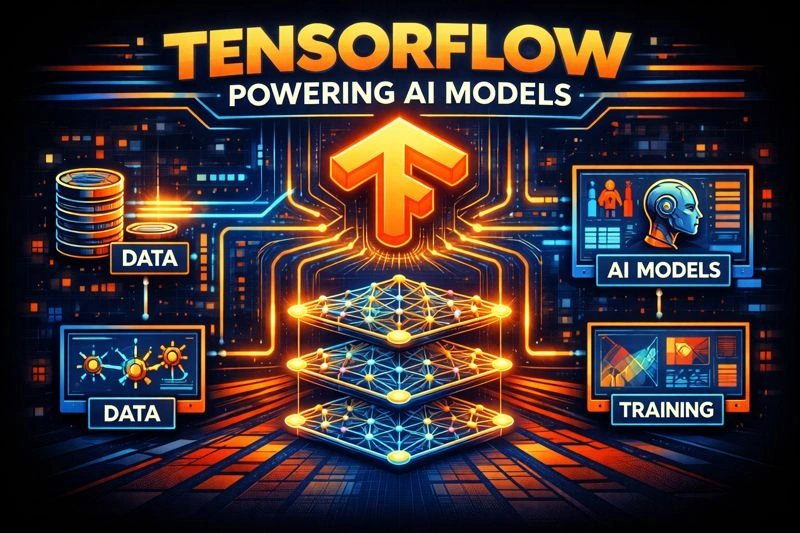
TensorFlow is one of the most significant frameworks in the history of artificial intelligence. Created by Google, this open-source deep learning library provides the foundation for building, training, and deploying machine learning models at scale. From academic research to commercial applications, TensorFlow powers many of the systems that define modern AI—from recommendation engines and chatbots to self-driving cars and medical diagnostics.
By simplifying how neural networks are developed and executed, it enables both experts and beginners to work efficiently with complex data. It bridges the gap between research and production, giving developers a unified platform for experimentation, optimization, and deployment.
In this article, we define the platform, explore how it works, trace its origins, and discuss its practical applications across industries. By the end, you’ll understand why it remains a cornerstone of deep learning innovation.
What Is TensorFlow
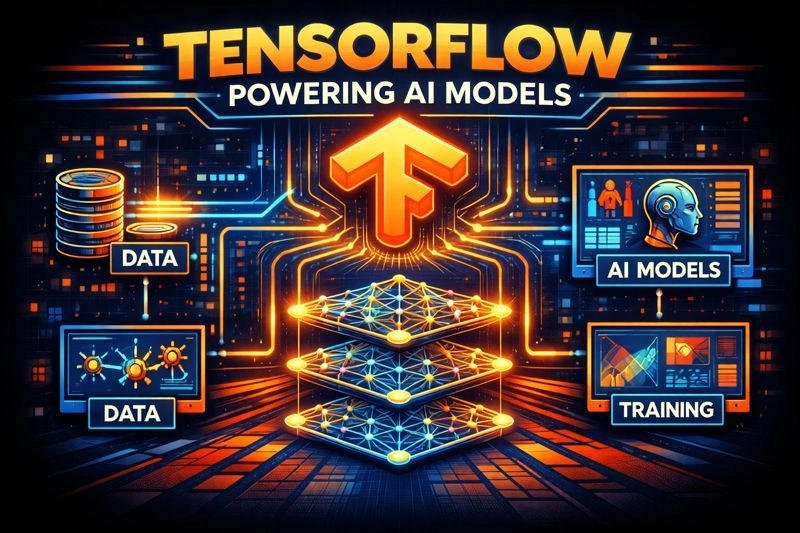
It is an open-source software framework for machine learning and deep learning, designed to make it easier to develop and train neural networks. It provides an extensive ecosystem of tools, libraries, and community resources that allow developers to design algorithms capable of recognizing patterns, processing images, generating predictions, and much more. As a result, it bridges the gap between research and real-world application, offering both flexibility and scalability for a wide range of users.
The name “TensorFlow” originates from its core concept: tensors, which are multidimensional arrays that store data, and flow, representing the movement of these tensors through computational operations. Together, they describe the framework’s architecture—a dataflow graph that connects mathematical computations in a structured and efficient way. In other words, it’s design allows complex operations to be expressed clearly, making it easier to visualize and optimize machine learning workflows.
Furthermore, it supports a wide range of machine learning tasks, from simple linear models to advanced neural networks such as convolutional neural networks (CNNs) and recurrent neural networks (RNNs). It’s written primarily in Python; however, it also supports other programming languages like C++, JavaScript, and Swift.
Because of its open-source nature, it has become one of the most widely adopted AI frameworks across the world. Ultimately, it stands as a cornerstone of modern AI development, empowering individuals and organizations to transform data into intelligent solutions.
Background of Tensorflow
It operates on a computational graph system where each node represents a mathematical operation, and each edge carries data in the form of tensors. When developers build a model, they define these graphs to represent the flow of information through various transformations—such as matrix multiplications, activations, or convolutions.
One of TensorFlow’s defining features is its scalability. The framework can run on a single laptop CPU, multiple GPUs, or even distributed clusters of servers.
At its core, TensorFlow uses automatic differentiation, a technique that computes gradients efficiently for optimization. This capability is crucial for training neural networks, as it allows the model to adjust weights and minimize error during backpropagation.
TensorFlow also provides two major programming interfaces: the low-level API, which gives full control over model architecture and training, and the high-level Keras API, which simplifies model building through an intuitive, user-friendly syntax. Developers can choose either approach based on their expertise and project requirements.
Another strength of it is its deployment ecosystem. Using TensorFlow Serving, TensorFlow Lite, and TensorFlow.js, developers can deploy models to cloud servers, mobile devices, or browsers. This versatility ensures that trained models can run efficiently across platforms, whether in edge devices or large-scale enterprise systems.
TensorFlow’s Eager Execution mode, introduced in later versions, allows for immediate computation without building static graphs first. This makes debugging easier and accelerates experimentation. Moreover, TensorBoard, its built-in visualization toolkit, enables users to monitor training progress, compare results, and interpret model behavior visually.
History or Origin of TensorFlow
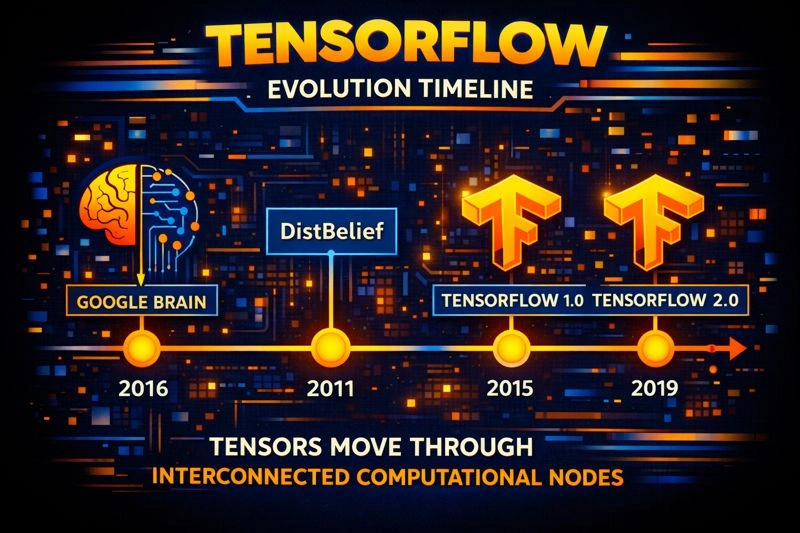
The origins of TensorFlow trace back to Google Brain, an AI research team dedicated to advancing large-scale neural networks. In 2011, Google developed an internal system called DistBelief to train deep learning models on distributed infrastructure. Although this system proved powerful, it was restricted to internal use and, therefore, lacked the flexibility required for broader applications across the emerging AI landscape.
As deep learning began to evolve rapidly, Google recognized the need for a more adaptable framework. Consequently, in 2015, the company released TensorFlow as an open-source successor to DistBelief. As a result, it provided a modular, transparent, and flexible environment that encouraged experimentation, innovation, and large-scale adoption.
Over the following years, TensorFlow continued to expand through several key updates. Notably, the release of TensorFlow 2.0 in 2019 marked a major milestone in its evolution. Furthermore, it simplified debugging and experimentation, making machine learning development smoother and more intuitive for all levels of expertise.
Today, TensorFlow powers many of Google’s most widely used products—including Gmail, Google Photos, and YouTube recommendations—and serves as the foundation for numerous AI-driven applications around the world. Beyond Google, the open-source community continues to enhance TensorFlow by contributing libraries, plugins, and pre-trained models that extend its capabilities. Ultimately, it remains one of the most influential frameworks in artificial intelligence, consistently driving innovation, accelerating research, and making machine learning more accessible to everyone worldwide.
Types of TensorFlow
TensorFlow offers various specialized versions tailored for different environments:
- TensorFlow Core: The full version used for training and deploying models on servers, desktops, and clusters.
- TensorFlow Lite: A lightweight version optimized for mobile and embedded devices, supporting on-device inference.
- TensorFlow.js: Enables running models directly in the browser using JavaScript, suitable for interactive web applications.
- TensorFlow Extended (TFX): An end-to-end platform for deploying production-ready ML pipelines.
- TensorFlow Hub: A repository of reusable pre-trained models for fast prototyping and transfer learning.
Each type empowers developers to build intelligent systems suited to specific deployment needs, from web apps to enterprise-scale machine learning pipelines.
How Does TensorFlow Work?
TensorFlow operates by constructing computational graphs where each operation is a node and each tensor represents flowing data. Users define these graphs either through the low-level API or high-level Keras models.
Once the model is defined, TensorFlow automatically computes gradients for optimization during training using backpropagation. This helps fine-tune the model by minimizing the error between predicted and actual outcomes.
After training, the model can be saved and deployed using TensorFlow Serving (for cloud), TensorFlow Lite (for mobile), or TensorFlow.js (for browser). This end-to-end pipeline ensures consistency from development to deployment.
Pros and Cons of TensorFlow
| Pros | Cons |
|---|---|
| Open-source and widely adopted | Steeper learning curve for beginners |
| Scalable across devices and servers | Verbose syntax in low-level API |
| Supports multiple languages | Competing frameworks may offer simpler setup |
| Powerful deployment tools | Performance optimization may require tuning |
Applications or Uses of Tensorflow
Machine Learning and Predictive Analytics
TensorFlow is widely used in building predictive models that analyze data trends, forecast outcomes, and detect anomalies. Businesses employ TensorFlow-powered systems to predict customer behavior, optimize logistics, and manage financial risks. Its ability to process large datasets efficiently makes it essential for big data analytics.
Computer Vision
In computer vision, it provides the foundation for image classification, object detection, facial recognition, and medical imaging. The framework supports pre-trained models such as Inception, ResNet, and MobileNet, which accelerate experimentation and deployment.
Natural Language Processing (NLP)
TensorFlow plays a central role in natural language processing (NLP) applications. Through its powerful architecture, it enables machines to understand and generate human language using advanced models such as transformers, sequence-to-sequence networks, and BERT. As a result, developers can build systems that process text contextually and respond intelligently to human input. Furthermore, these models form the backbone of many real-world tools, powering chatbots, translation systems, sentiment analysis platforms, and voice assistants. In this way, TensorFlow brings natural interaction between humans and machines closer to reality, bridging the gap between computational reasoning and everyday communication.
Speech Recognition and Audio Processing
TensorFlow underpins many modern speech-to-text and voice recognition systems, serving as the foundation for accurate and efficient audio processing.In addition, TensorFlow integrates seamlessly with various signal-processing libraries, enhancing its ability to interpret complex sound patterns. As a result, it transforms raw audio data into meaningful, structured information that drives today’s most advanced communication technologies. Ultimately, this combination of precision and adaptability makes TensorFlow an essential tool for building intelligent, voice-driven applications.
Robotics and Automation
In robotics, it enhances perception and control. Robots equipped with TensorFlow models can recognize their surroundings, plan movements, and execute precise actions. Whether sorting packages in warehouses or performing delicate medical procedures, TensorFlow helps machines respond intelligently to their environments.
Healthcare and Life Sciences
Researchers in healthcare rely on TensorFlow for analyzing medical data, predicting disease progression, and discovering new drugs. It supports deep learning pipelines that can detect anomalies in medical scans, recommend treatments, or assist in genetic research. Its efficiency in processing large and complex datasets has accelerated breakthroughs in precision medicine.
Edge Computing and Internet of Things (IoT)
Through TensorFlow Lite, models can be optimized for low-power devices like smartphones, sensors, and microcontrollers. This makes AI accessible even in remote or resource-constrained environments, supporting smart cameras, wearable devices, and autonomous drones.
Collectively, these applications highlight TensorFlow’s versatility. Whether running on powerful data centers or compact mobile devices, it remains an indispensable tool for advancing real-world artificial intelligence.
Resources
- TensorFlow: Official Website
- Google AI Blog: The Evolution of it
- GitHub Repository: Framework Repository
- OpenBenchMarking: Benchmarks
- Medium: How it Powers Modern AI Applications