
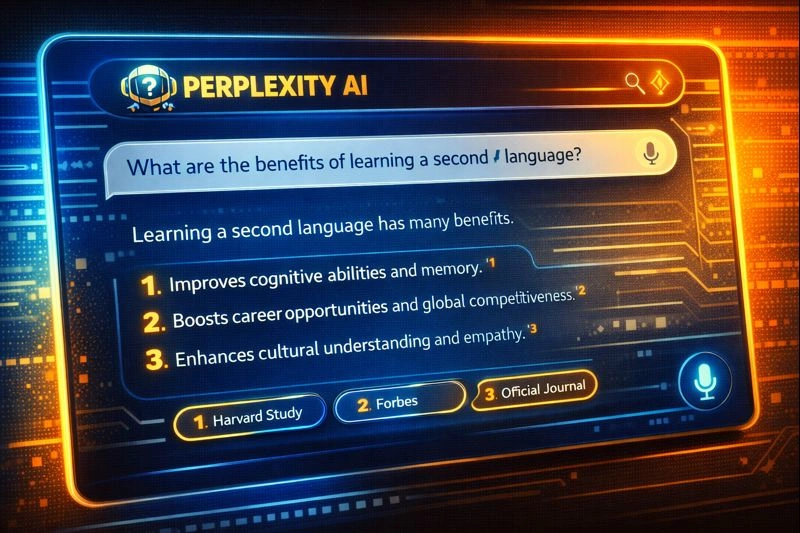
Developed as one of the most innovative advancements in modern search and artificial intelligence, Perplexity AI redefines how people find and understand information. Instead of displaying a long list of links like a traditional search engine, this technology delivers clear, cited answers directly to user queries. It blends real-time data retrieval with advanced language models to transform how individuals, researchers, and businesses explore knowledge.
This AI system functions as a conversational answer engine—a platform that interacts naturally with users while grounding every response in verifiable sources. Its rise marks a major step toward an era of transparent, intelligent, and context-aware search. In doing so, it bridges the gap between human curiosity and machine understanding.
In this article, we define Perplexity AI, explain how it works, and look into its origin. We also explore its applications in research, education, technology, business, and creative content. By the end, you’ll have a clear understanding of how this AI-powered system is shaping the future of digital search and reasoning.
What is Perplexity AI
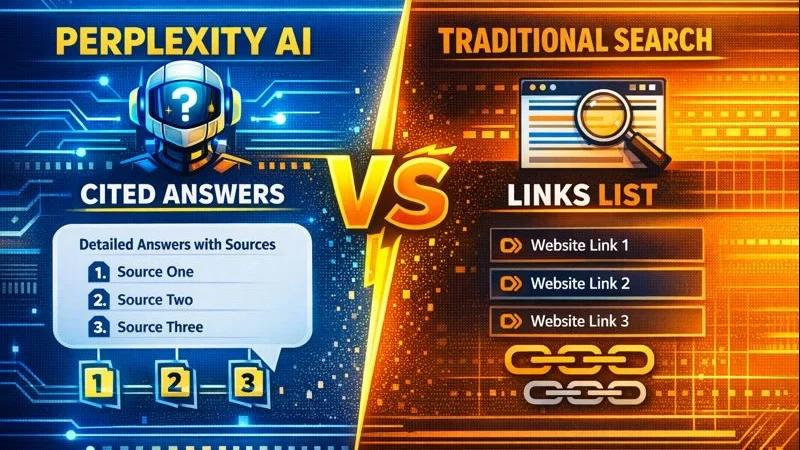
Perplexity AI is an AI-driven question-answering system created by Perplexity AI Inc., a company focused on combining artificial intelligence with real-time information retrieval. It operates as a hybrid search and chat system, built to understand natural language, analyze intent, and provide fact-based answers that include citations to reliable sources.
At its core, the definition centers on a model that merges language understanding with retrieval-augmented generation (RAG). This means it doesn’t just generate text—it actively pulls in information from current web pages, databases, and academic references to form accurate and timely responses. Users can ask questions in a conversational way and receive results that read like expert summaries rather than search engine lists.
This AI assistant is often described as a “research companion” or “AI search assistant.” Each of these labels points to its dual strength: powerful natural language processing paired with verifiable data sourcing. It aligns closely with human communication, producing responses that are not only coherent but also grounded in truth.
By integrating retrieval and generation, Perplexity represents a new category of AI technology. Instead of replacing search engines, it enhances them—offering context, structure, and reasoning in every response.
Background of Perplexity AI
The technology behind Perplexity combines machine learning, neural retrieval, and generative models to deliver precise information through an interactive interface. When a user enters a query, the system first interprets the question’s context. It then identifies keywords, related concepts, and intent in order to understand exactly what the person is asking.
After processing the query, the system moves on to retrieve information from a range of trusted online sources—including academic papers, verified news outlets, and data-driven publications. Next, the model synthesizes that data through its language generation layer, crafting a natural-language explanation that answers the question directly. Most importantly, every piece of information includes citations or links to its source, so that the user can verify the credibility of the response.
In contrast, Perplexity operates using a retrieval-augmented generation framework, which clearly differentiates it from purely generative chatbots. While tools like ChatGPT or Claude rely heavily on pre-trained data, this AI platform’s responses evolve dynamically through live web retrieval. As a result, users always receive up-to-date information aligned with current events and research.
Origin or History of Perplexity AI
Perplexity AI was founded in 2022 by Aravind Srinivas, a former researcher from OpenAI and DeepMind. Along with a team of engineers, Srinivas aimed to build a transparent AI search assistant that could provide factual answers with sources. They launched the first public version of the platform in late 2022.
As it gained traction, Perplexity expanded its accessibility through mobile apps and browser plugins. By 2024, the platform had introduced Perplexity Pro, which integrated larger language models and advanced tools for professionals. This made it a direct competitor to ChatGPT and Google Gemini.
| Year | Milestone |
|---|---|
| 2022 | Founded by Aravind Srinivas |
| Late 2022 | Launch of public Answer Engine |
| 2023 | Rollout of mobile apps and browser extensions |
| 2024 | Launch of Perplexity Pro with enhanced features |
Types of Perplexity AI

Perplexity AI can be categorized into several versions based on user needs and technical capabilities:
- Standard Perplexity: Available to all users, offering basic question-answer functionality with citations and web access.
- Perplexity Pro: A premium version with access to larger models, file upload capabilities, and topic tracking tools.
- Mobile and Browser Extensions: Streamlined for quick searches and questions on the go.
- Developer Tools: APIs and integrations that developers can use in apps or platforms.
Each type serves a unique user group—casual users, professionals, educators, and developers—making the platform widely adaptable.
How Does Perplexity AI Work?
Perplexity AI operates through a seamless process:
- User submits a question in natural language.
- The system analyzes the intent, context, and key terms.
- It retrieves relevant data from current online sources, academic databases, or trusted media outlets.
- An AI model synthesizes the response, citing the source links.
- The user receives a conversational, fact-based answer.
This efficient workflow ensures clarity, speed, and accuracy in every search.
Pros and Cons of Perplexity AI
Perplexity AI offers powerful capabilities, but it’s not without limitations. Here’s a quick comparison:
| Pros | Cons |
|---|---|
| Real-time, cited answers | Limited offline functionality |
| Simple, clean user interface | Not all sources may be accessible |
| Suitable for multiple industries | Dependent on internet connectivity |
| Reliable for fact-checking | Some responses may require refining |
| Integrates with mobile and browser | Premium features behind a paywall |
Applications or Uses of Perplexity AI
Perplexity’s versatility allows it to serve multiple sectors, from education to enterprise environments. Its design makes it suitable for professionals who need concise summaries, technical explanations, or quick insights backed by evidence.
Research and Academia
In the academic world, Perplexity acts as a digital research assistant. It helps students and scholars interpret complex subjects, locate relevant studies, and summarize academic literature. Because it provides references with every response, it is particularly useful for academic writing, citation tracking, and literature reviews. Researchers can use it to understand theories, explore related work, and identify credible sources faster than traditional search methods.
Business and Data Intelligence
Organizations use the AI platform to extract insights from the web and internal data. It can summarize reports, analyze market trends, and generate insights for strategy development. Its real-time retrieval ensures that business leaders receive accurate updates about competitors, industries, or emerging technologies.
Technology and Development
For developers and IT professionals, Perplexity functions as a technical guide. It assists with debugging, API exploration, and code interpretation. Instead of searching through long documentation manually, engineers can ask direct questions like “How do I integrate this API with Python?” and receive clear, sourced explanations. The system often points to trusted sites such as Stack Overflow or GitHub, enabling efficient problem-solving.
Education and Learning
Educators and learners benefit from its ability to explain difficult concepts in simple terms. Teachers use it to create lesson plans, quizzes, and summaries, while students rely on it to study topics interactively. Its conversational nature supports different learning levels, adapting responses for beginners or advanced users. For self-learners, it becomes a personalized tutor that provides explanations, definitions, and context across subjects.
Journalism and Media
In newsrooms and editorial teams, Perplexity assists writers in fact-checking and contextual analysis. Reporters can quickly confirm statistics or cross-reference quotes before publication. The presence of citations ensures accountability and transparency—qualities crucial for ethical journalism. The AI also helps in summarizing press releases, identifying story angles, and generating topic outlines, allowing journalists to focus more on creative storytelling.
Creative Content and Writing
Writers and content creators use the assistant as a creative partner that can draft outlines, suggest headlines, and summarize articles. Its fluency in natural language makes it suitable for producing scripts, blog drafts, and editorial material that can later be refined by human editors. Because it integrates factual information, it helps creators maintain credibility while saving time in research.
Finance and Investment
Analysts and investors turn to the platform for market overviews, company analysis, and trend identification. The AI can interpret economic data, summarize reports, and highlight key indicators. While it does not replace financial experts, it serves as an effective tool for quick data retrieval and preliminary research before deeper analysis.
Everyday Use
For general audiences, Perplexity simplifies daily learning and discovery. Whether planning a trip, comparing products, or checking the latest developments in science, users appreciate the direct, citation-backed responses. It eliminates the noise of sponsored links and irrelevant ads, focusing purely on reliable information.
Resources
- Perplexity AI: Official Website
- TechCrunch: Perplexity AI aims to reinvent search with conversational answers
- Forbes: How Perplexity AI challenges Google and ChatGPT in the search space
- VentureBeat: The rise of answer engines: Why Perplexity matters
- Wired: Inside Perplexity AI’s quest for transparent intelligence